Write an honest opening that earns attention
An opening should tell a viewer what useful thing the Reel will show. Curiosity is welcome; a promise the video cannot keep weakens trust.
Name the audience question
Before writing a hook, finish this sentence: “The person watching wants to know …” If you cannot name the question, a dramatic opening will not rescue the video. Choose a topic you can demonstrate, explain or answer in the available time.
For a bicycle repair tutorial, “How can I tell whether this tire is underinflated?” is a clearer starting point than “The secret every cyclist ignores.” The example is editorial, not a claim about platform performance.
Put proof near the promise
Show the finished object, the relevant tool or the question on screen early. Then explain what the viewer will learn. A food creator can show the actual crumb before explaining a mixing decision; a studio can show the draft and final frame before discussing lighting. Do not imply that a personal result applies to everyone.
Edit without bait
Read the opening next to the final cut. Does the video answer its own question? Are before-and-after images comparable? If the answer changes during editing, rewrite the first sentence. Add readable captions and describe visual steps in speech or accompanying text.
The promise-and-proof card
Use this before recording and again before publishing. The diagram is described immediately below it.
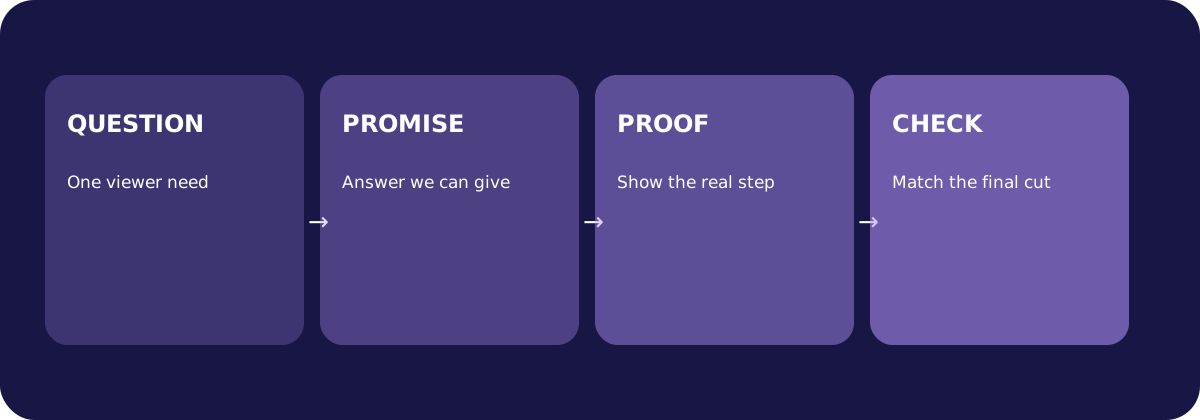
Text version: Start with one audience question. State a promise the Reel can fulfill. Show proof or a demonstration early. End with a useful next step, without inventing an outcome.
- Question: What is the viewer trying to decide or do?
- Promise: What exact answer can this recording give?
- Proof: What image, step or source makes the answer credible?
- Check: Does the published cut still contain the promised answer?
- Avoid: This will fix every slow video
Try: Here is one edit that makes the first step easier to see - Avoid: Nobody knows this Instagram secret
Try: We tested two ways to frame the same tutorial - Avoid: The only camera setting you need
Try: See how exposure changes in this room - Avoid: Make your business viral today
Try: Show a customer the detail you check before delivery - Avoid: Stop doing everything wrong
Try: One common caption mistake, and a clearer version - Avoid: You must post at this exact time
Try: How we choose a posting time we can sustain - Avoid: The algorithm hates your account
Try: Three things we can actually review in our content - Avoid: Everyone is using this trick
Try: Watch how this opening sets up the demonstration - Avoid: Instant results, guaranteed
Try: What changed after we simplified the first sentence - Avoid: Wait until the shocking ending
Try: The result is here first; now see the steps
These are original copy examples, not performance-tested hooks. Try variants with your own audience and evaluate whether viewers receive the promised answer, not only whether they pause.
PRIMARY CONTEXT / Instagram Best Practices ↗. Checked 30 September 2026. The promise-and-proof card is our own editorial method.